
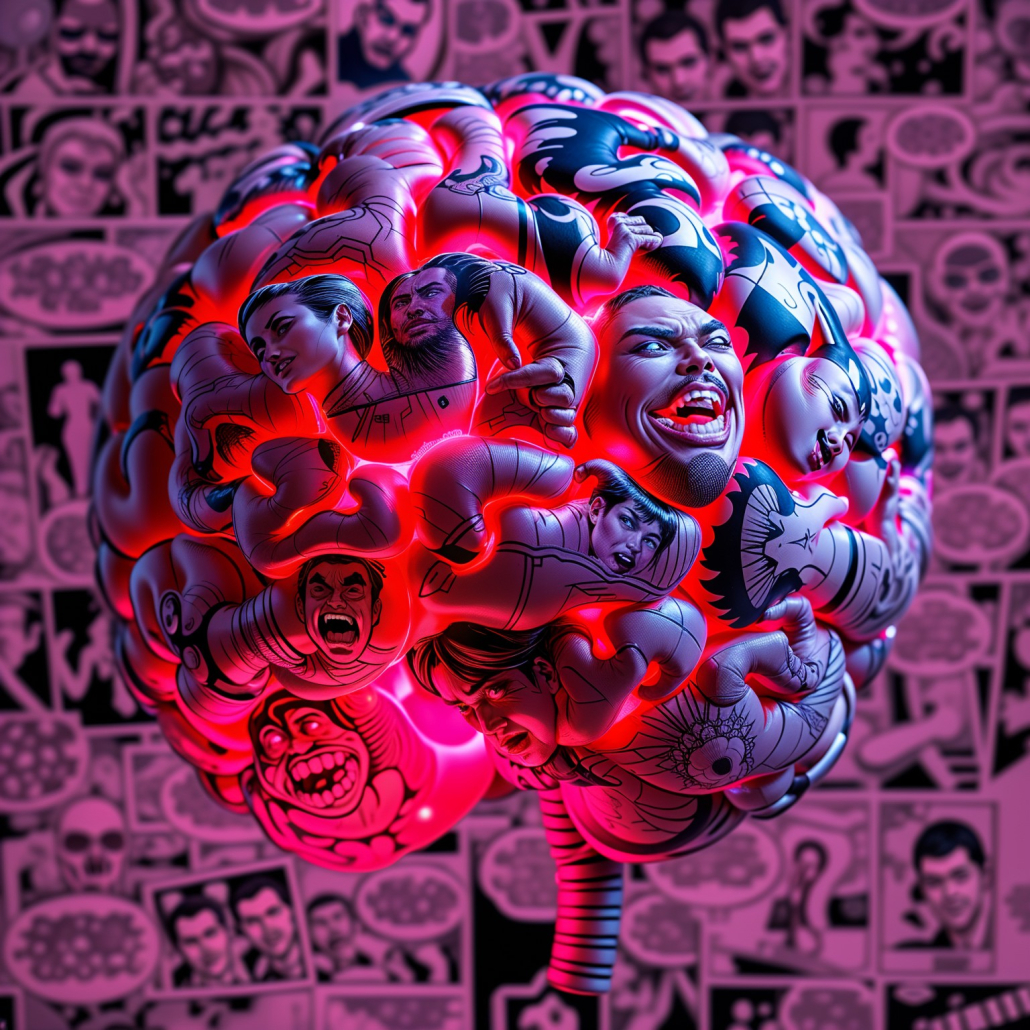
 AI Generated
Comic Books Rot the Brain!
We’ve all heard it in one way or another. Now we hear it more about video games, but it’s the same disapproving vibe as the anti-comic ideology. Seventy years ago, the words of Dr. Fredric Wertham were used to criticize comic books which he accused of tainting our youth. Carol L. Tilley wrote an article about this after the truth about his research was released in 2010 called “Seducing the Innocent: Fredric Wertham and the Falsifications That Helped Condemn Comics.” I won’t bore you with the details except for one quote from the beginning of the article, “Wertham manipulated, overstated, compromised, and fabricated evidence—especially that evidence he attributed to personal clinical research with young people—for rhetorical gain.” If you want to read more, you can find the article for free through Academic Search Premier using your MORE library card on the statewide service, Badgerlink. Despite the obvious lack of integrity in his research, there are many who will parrot his pessimism, even though most likely have no idea who he is.
Comic derivative media receives quite a bit of disapproval as well. The likes of Scorsese and Coppola have publicly criticized the popularity of comic book movies for their impact on cinema. Quentin Tarantino has discussed the “Marvel-ization” of Hollywood and how superhero movies is all that studios and fans want anymore (It should be noted that he has been involved in other comic book adaptations and uses techniques that are heavily influenced by sequential art). Even the prolific comic book writer, Alan Moore, has accused the comic book movie viewership for being immature and has said that he is apologetic for his contribution to comic books in general for perpetuating fascist ideals. Many clickbait news outlets will embellish some of the statements made by celebrities, but these few have been very vocal about their opinions on the medium.
 Now, it isn’t all doom and gloom. The real motivation for this blog post comes down to one man and his endeavors to popularize and bring recognition to what he coined as “sequential art” and also created the concept of the graphic novel. We celebrate this man annually in two ways. First, this blog is being posted during Will Eisner Week which takes place March 1-7 every year. This is to remember Eisner’s passion and his positive impact on sequential art. Second, the Eisner Awards are awarded for several categories across multiple formats of sequential art and is announced annually at the Comic-Con International: San Diego in July where the industry’s best are recognized for their creations and contributions to sequential art.
If you want to read Will Eisner’s work, we have several of his graphic novels that you can put on hold from the MORE Consortium, including The Contract With God Trilogy or A Contract With God and Other Tenement Stories. We also have a collection of his comic book series, The Best of the Spirit, Will Eisner’s The Spirit Archives, or Will Eisner’s The Spirit. If non-fiction is your cup of tea, we have Comics and Sequential Art or Will Eisner: A Dreamer’s Life in Comics.
Wherever one sits on the spectrum of ideals, it’s apparent that sequential art has had an uphill battle for the better part of a century, but they continue to sell and many professionals, educators, and readers will testify to their value, in particular with the effectiveness regarding reluctant readers. But, that’s for another blog post.
As a fun little addition, I have decided to share a glossary for those who find all of the nomenclature confusing. I will preface this by saying that there are many opinions on how these are defined and the following is how I personally view these definitions. Please feel free to respectfully share your opinions in the comments below.
Sequential Art – Will Eisner coined this term to describe any sequence of images that are used to convey a story or message. Comics are the most popular method, but many other forms of sequential art exist such as storyboards, story blankets, hieroglyphics, and more.
Comics – The term is used very broadly in the United States and may be used to generalize all of the following definitions.
Cartoon/Comic Strip – A drawing in a panel, or panels for a comic strip, often used to convey humor or social commentary. They may be found in newspapers or collected into large volumes.
Comic Book – Short, often serialized, works consisting of images in panels that are printed in a magazine or digital format. The magazine format is thin, flimsy, and not designed for wear and tear like a bound book. Though the comic book is short, they are often written with longer story arcs that can branch across many issues and may become very complex.
Graphic Novel – This one can be the most contentious because it is used by libraries and bookstores more liberally than some fans prefer. The graphic novel term was coined by Will Eisner and is meant to describe a more substantial novel-like length than what you would find in a comic book. Another point of contention is in the definition. Some accept a compilation of comic books as a graphic novel while others believe it must have been originally written as a complete graphic novel and not been serialized beforehand.
Webcomic/Webtoon – This is another one of those loose definitions. Some would say that any digital format of a comic is a webcomic, while others would narrow that down to comics specifically intended for digital distribution, even if they are printed at a later date.
Manga/Manhua/Manhwa – These terms refer to sequential art from Japan, China, and Korea respectively. Unlike Western comics that are often colorful, sequential art from these Eastern countries are usually black and white. There are also noticeable differences in how stories are told in Western versus Eastern media. Another key difference is how these comics are shared; Japanese manga, for example, is often released in small sections in magazines before being grouped into book volumes, which is how we typically find them in the United States. One of the most popular manga magazines, Shonen Jump, is available here, although we don’t have it in the MORE system.
Sources
“Martin Scorsese Says Marvel Movies Are “Not Cinema”” by Cameron Bonomolo, comicbook.com, October 3, 2019
“Francis Ford Coppola Clarifies His Comments On Marvel Movies” by Matthew Aguilar, comicbook.com, October 29, 2019
“Quentin Tarantino Bemoans the ‘Marvel-ization’ of Cinema: Actors Who Star in Comic Book Films Are ‘Not Movie Stars’” by Candice Ortiz, MediaIte, November 21, 2022
“Alan Moore Gives Rare Interview: ‘Watchmen’ Creator Talks New Project ‘The Show’, How Superhero Movies Have “Blighted Culture” & Why He Wants Nothing To Do With Comics” by Tom Grater, Deadline, October 2020
“”The Superhero Dream Is Essentially Fascism”: Alan Moore Eviscerates Superheroes & Fixes Pop Culture in In-Depth Interview” by Andrew Firestone, Screenrant, October 4, 2023
Some images above were generated by AI.



Add a Comment
Now we'd like to hear your thoughts! Comments and suggestions are welcome!