Use your web browser’s BACK button to return to the gallery.
The Sins of Us Triptych
Ellen Mahaffy
photography
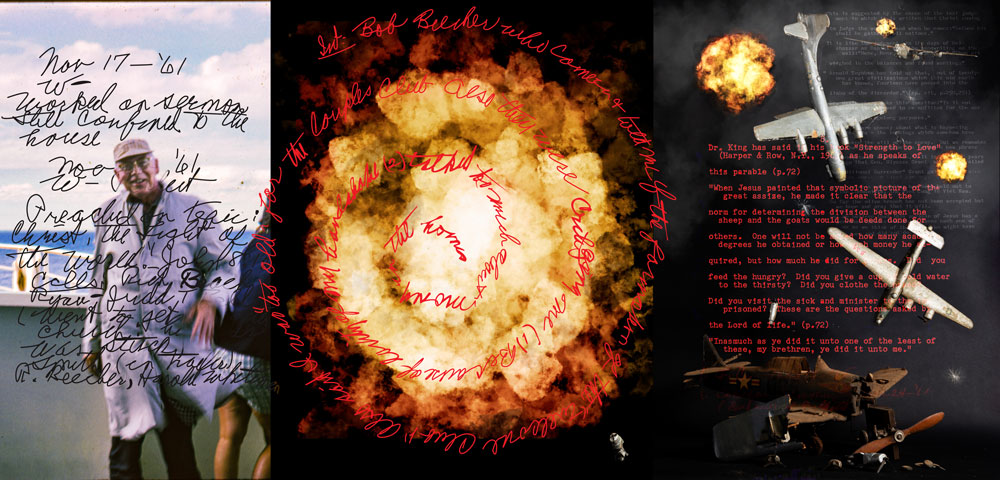
“My grandfather was a Presbyterian minister. After his death, I inherited his sermons, diaries, and photographs, hoping to learn more about him and my father. As a queer person, I’ve wondered whether he would have accepted me. His faith was strict—no drinking, smoking, or dancing. When I was 19, I learned my father was adopted, which made me question the narrative I’d been given about my family. My father recalls his own father fondly but feared his mother. Reading through my grandfather’s 1961 diary, I found a passage written in red ink where he recorded being excluded and criticized by church members—told he was too old for the couples club and scorned for the levity of his handshake and talking too much about money in homes. The triptych layers these inherited fragments. The left panel shows my grandfather’s diary entry overlaid on a vacation snapshot my grandmother took of him. The motion blur and his smile give the image an unexpected tenderness, even a queer quality—a moment of joy and vulnerability. The center panel spirals that red-ink diary entry around a mushroom cloud, the apocalyptic imagery echoing Cold War anxieties and the weight of institutional rejection. The right panel juxtaposes my father’s childhood toy planes with an excerpt from my grandfather’s May 15, 1965 sermon “The Sins of Most of Us,” where he quotes Dr. Martin Luther King Jr.’s Strength to Love. King’s parable asks: “When Jesus painted that symbolic picture of the great assize, he made it clear that the norm for determining the division between the sheep and the goats would be deeds done for others… Did you feed the hungry? Did you give a cup of cold water to the thirsty? Did you clothe the naked? Did you visit the sick and minister to the imprisoned?” The work holds the tension between judgment and compassion—between a church that critiqued handshakes and a minister who preached King’s radical call to love. The toy planes—relics of a Cold War childhood, symbols of both innocence and instruments of war—float against these questions of moral accounting. What my grandfather preached and what he endured exist side by side, asking what we inherit and how we’re called to live. These questions feel urgent now—in a time when faith is again weaponized to exclude, when we debate who deserves compassion, and when the ‘least of these’ are determined by political convenience rather than human need.”
Size: 17″ x 36″
Price: $1200
Contact aprilhc@eauclaire.lib.wi.us for details.