


Celebrating the ADA’s 34th Anniversary: A Conversation with Dr. Katherine Schneider
 In honor of the 34th anniversary of the signing of the Americans with Disabilities Act we have a special edition blog cowritten by Katherine Schneider, Ph.D., Senior Psychologist, Emerita at UW-Eau Claire.
The Americans with Disabilities Act was signed into law on July, 26, 1990, by President George H.W. Bush. The law prohibits discrimination based on disability. ADA disabilities can include both mental and physical medical conditions and do not need to be severe or permanent to be considered a disability.
Dr. Katherine Schneider has been blind from birth. Having lived half of her life before the ADA was in effect, she celebrates the changes the ADA has made, and will continue to make, in her life. Some examples of how Katherine is able to navigate independently:
• With the use of audio and a touch screen voting machine, Katherine can vote by herself.
• Utilizing the Braille numbers in an elevator she is able to select the floor that is needed rather than selecting all floors and counting the number of stops until arriving at the desired floor.
• She also has a Seeing Eye dog that is allowed by law in public places in every state.
When asked what her life looks like with a disability, she answered: “I’ve written three memoirs and a children’s book that answer that question fully, (of course all my books are available at the library), but the short answer is: it’s different because I have to ask/advocate for what I need, it takes more time, energy and money to accomplish the same things, I have to work extra hard to connect with people (it was horrible during the pandemic when people were keeping their distance from each other), and it’s made me a better person — more aware of people’s needs, more joy in accomplishing simple tasks and more aware of the humorous potential in awkward situations.”
More from Katherine:
I’ve had 75 years to experience the portrayal of people with disabilities in books and compare it with my lived realities. I’m so passionate about it that I started an award with the American Library Association for children’s and youth books with realistic portrayals twenty years ago and, more recently, an award for good journalism through the National Center for Disability Journalism of the Walter Cronkite School of Journalism at Arizona State University. To build your TBR list for the upcoming anniversary of the ADA, here are some great reads:
Memoirs have morphed from “triumph over” a disability to nuanced pictures of life with the disability. More intersectional memoirs and more emphasis on disability issues make them educational instead of cloyingly inspirational. Some you might like (published in the last five years) include: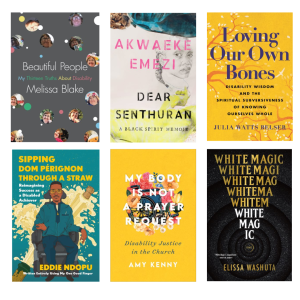
• Beautiful People: My Thirteen Truths about Disability by Melissa Blake
• Being Seen by Elsa Sjunneson (deaf blind media critic)
• Dear Senthuran by Akwaeke Emezi (queer, disabled Black writer)
• White Magic by Elissa Washuta (bipolar indigenous writer)
• Sipping Dom Perignon Through a Straw by Eddie Ndopu (spinal muscular atrophy)
If you’re interested in religion and disability, you might enjoy:
• My Body Is not a Prayer Request by Amy Kenny
• Loving Our Own Bones by Julia Watts Belser
I started the Schneider Family Book Awards because when I was growing up, there were biographies of Louis Braille and Helen Keller and that was about it for disability representations, other than Tiny Tim and the Little Lame Prince. The winners chosen by the librarians have shown the increasing range of lives pictured and the complexity of those lives with single parent families, love affairs, teen angst, etc. for kids with disabilities. Personal favorites are biographies like Looking Out for Sarah by Lang, Rescue and Jessica by Kensky and Listen by Stocker because they picture real adults with disabilities and two of them involve dogs.
When I asked about the lack of representation that Katherine felt while growing up, she told me there weren’t many books available in Braille or recorded books. While it is much better today, she still must utilize several facilities in order to get books. These include:
• Several libraries
• WI Talking Book and Braille
• Xavier Society for the Blind
• Bookshare
While she has these resources at her disposal, there are times when books are still not available in a format that works for her. An example would be graphic novels. Only a few have been recorded and described, there is still more work to be done. Katherine states, “I’m happy with how representation and access have improved, but I’m greedy for more!”
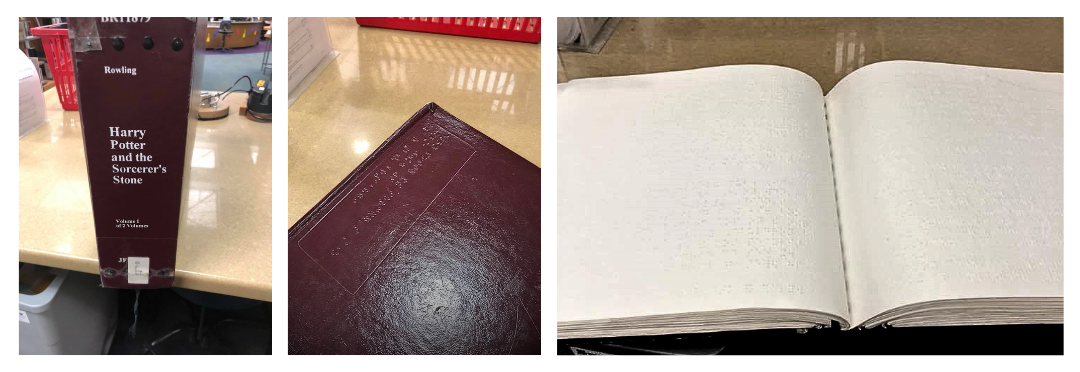
A copy of “Harry Potter and the Sorcerer’s Stone” in Braille that we had at the library a few years back
If you’re looking for ways to celebrate ADA month, here are some of Katherine’s suggestions:
• Watch a video with audio description turned on with your eyes closed to see what movies are like for blind folks.
• Use a few words to describe the Facebook picture you post; e.g. “look at this beautiful chocolate cake I just baked” instead of “Wow look at this”; I can’t see it either way but at least I know what you’re happy about.
• Show your kids some of the Schneider Family Book Award books featuring life with disabilities included.
• Celebrate ADA 34; and finally,
• When you see me, say “hi”; don’t just wave or honk.
While there is always more that can be done, I wanted to share with you how we at the library are supporting individuals with disabilities:
• Beyond the traditional format of books we also have Large Print books and audiobooks in our collection.
• If you utilize eBooks through Libby and Hoopla there is the option to adjust the size of the font, the style of the font (including OpenDyslexic font – a font designed against some common symptoms of dyslexia); and the background lighting. Not sure how to make these changes? Stop in at Reference Services on the second floor and we would love to help you!
• Did you know we have a Braille printer?! Need documents printed in Braille? Fill out this form.
• The library’s remodel included concrete floors and wide aisles to accommodate mobility aids, and all event spaces have microphones and hearing assistance devices.
• In the Library of Things, you can find beep baseball equipment, colorblind glasses, memory kits, neurodiversity tools for kids, and a natural vision impairment kit.

Add a Comment
Now we'd like to hear your thoughts! Comments and suggestions are welcome!