
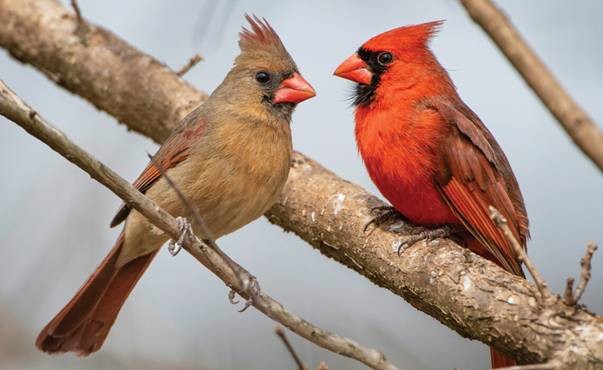

Backyard Birding
Spring is here! Grass is growing greener, trees are leafing out, and early flowers like daffodils and crocuses are blooming. Along with them come the birds. After a long winter, many species are returning from migration and are busy singing, nesting, courting, and defending territory. Spring is when birds are the most active, loudest, and easiest to spot, making it one of the best times to start birdwatching right outside your window.
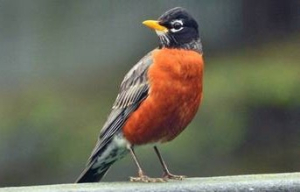
A cheerful robin
For me, the first sign of spring is the return of the robin. Hearing its cheerful song early in the morning always lifts my spirits. This year I spotted my first robin on March 7, hopping around a nearby yard. Most robins that nest in Wisconsin migrate south in November when food becomes scarce and return in March or April. Many return to the same nesting areas each year, so it may even be the same birds serenading you before sunrise as last year.
Robins are early nesters, and recently I found half of a beautiful blue robin’s eggshell in our yard, a sign that nesting season is underway. Not all robins leave for the winter, though. Some stay in Wisconsin, forming flocks that move around in search of food. We’ve seen them gather in winter to feast on the berries of a hackberry tree in our boulevard or briefly take over our deck to drink from the heated birdbath before moving on. Fun fact: the American Robin has been Wisconsin’s state bird since 1949.
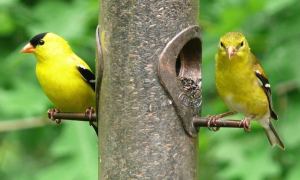
A pair of American Goldfinches
Another sign of spring is seeing the bright yellow of the American Goldfinch. In winter, the males wear dull brown feathers, but in spring they molt into the brilliant yellow birds that give them their name. The females stay a softer olive-yellow year-round. Lately, whenever I glance at our thistle feeder, there seems to be a pair of goldfinches feeding across from each other. Goldfinches are primarily seed eaters and love Nyjer (thistle) seed. They nest later than many birds, usually in mid to late summer, using plant fibers and thistle down to build tightly woven nests that can even hold water. A group of goldfinches is charmingly called a charm.
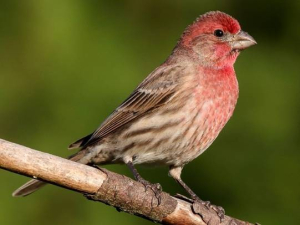
A homey House Finch
We also host House Finches each year. A pair builds a nest under the eaves of our second-story porch every spring. A previous homeowner placed a large decorative owl there, presumably to scare birds away, but the finches often nest right beside it, as if it were a friendly guardian. From our living room windows, we can sometimes see the chicks stretching their beaks open as they wait for their parents to return with food. House Finches frequently visit our black oil sunflower feeder and rarely stray far from their nest.
One of my favorites is the Black-capped Chickadee. These tiny birds stay in Wisconsin year-round and are regular visitors to our sunflower feeder, even during snowstorms. Chickadees take one seed at a time, fly to a nearby branch to crack it open, and then return for another. They are curious and seemingly fearless. When I refill the feeder or birdbath, a chickadee will often perch nearby calling out its familiar “chick-a-dee-dee-dee.” Sometimes they will come sit just a few feet away while I am sitting outside and “hang out” with me for a bit.
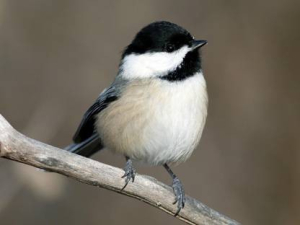
A fearless chickadee
We have quite a variety of birds that visit our yard including cardinals, hummingbirds, sparrows, juncos, woodpeckers, blue jays, catbirds, mourning doves. Occasionally a Sharp-shinned Hawk even patrols the area, hoping to catch an unsuspecting visitor.
You don’t need much to start enjoying birds in your own backyard. We have three feeders: one for Nyjer seed, one for sunflower seed and one for a simple, homemade nectar for hummingbirds in the warmer months. We also have a birdbath that stays out year-round.
If you’d like to learn more, the library offers books, audiobooks, DVDs, and guides for all ages about feeding birds, identifying species, and exploring birdwatching. Birding memoirs are also a wonderful way to experience the joy of birds through personal stories. Stop by and discover resources that can help you start birdwatching right in your backyard.



Add a Comment
Now we'd like to hear your thoughts! Comments and suggestions are welcome!