

Algonquian Language in Wisconsin
If you’re from Wisconsin, you have likely been subjected to a number of awful jokes and criminal mispronunciations involving our place names. From Wauwatosa to Manitowish, our “most difficult” to say place names often have origins in one of many Indigenous languages in Wisconsin. The Algonquian languages tend to be the most common, particularly Ojibwe and its relatives – Menomonee, Potawatomi, and Cree. Though not quite as common, there is also plenty of Ho-Chunk and Oneida language woven into Wisconsin’s language quilt. All of this said, as an Ojibwe student I will be focusing mostly on Ojibwe and closely related Algonquian languages.
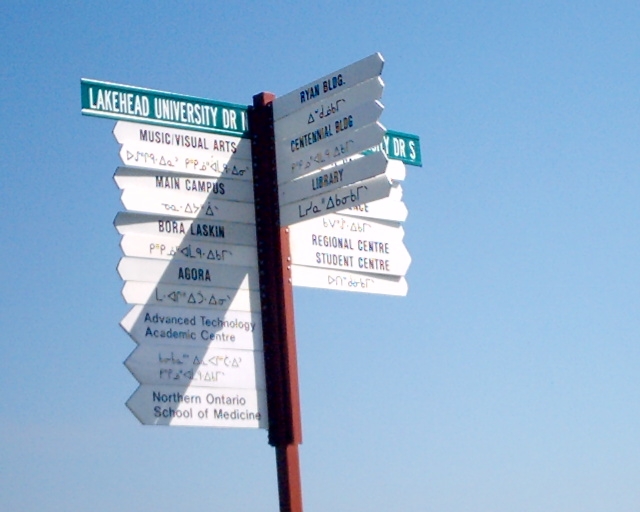
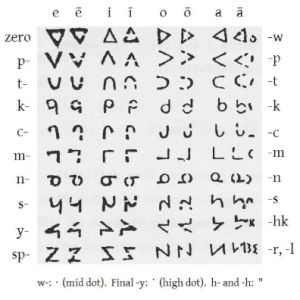 Ojibwe is one of the most widely spoken Indigenous languages north of Mexico and is a senior member of the Algonquian family. It does not have a standardized writing system, though the most popular are the Fiero double vowel system and the Canadian Aboriginal syllabics (CAS). CAS were developed in the 1840s specifically for writing polysynthetic languages like Ojibwe and Cree when James Evans concluded that French and English orthographies were too clunky. Those clunkier systems using the Latin alphabet, derived from French or English orthographies – like Fiero’s – are how we ended up with those “complicated” place names. Pictured to the right is Evans’ original manuscript. Fun fact: the word “Chippewa” is even a victim of these chunky writing systems!
So, now that I’ve explained the origins of the awful jokes, let’s talk about some of the places these languages pop up and what their words mean! My original inspiration in writing this is the ever present “wau” in Wisconsin. Waukesha, Wausau, Wauwatosa, Milwaukee, Kewaunee… I could go on and on. I was thrilled to find this WPR segment with a pair of UW professors discussing exactly that. It’s not super clear cut, for the simple reason of how many languages Wisconsin is home to. Native Ojibwe speaker and current UW-EC professor Brian McInnes explains that, in Algonquian languages, the “wau” syllable often refers to bursts of brightness and doubling the syllable refers to intermittent flashing. His example was Wauwatosa, which is reminiscent of the old Potawatomi word for “firefly”. However, if you look at Wausau, where the syllable is more literally doubled, the origin is more likely in the Ojibwe word waasa, meaning “far away” or “distance”. And then Milwaukee, which comes from the Algonquin* word Millioke, meaning either “The Good Land” or “Gathering place by the water”. So, in the case of “wau”, there is way more than one answer.
*Algonquin is a distinct language within the Algonquian family.
Another word, or syllable set, that I oft notice is Manitou (ᒪᓂᑑ in Canadian Aboriginal syllabics, notice how concise that is?!). This shows up in Manitowoc, Manitowish, and the many different Manitou Islands. Manitou has origins in a handful of Algonquian languages, though the Ojibwe origin of the word is manidoo, meaning a spirit or god. Manitowoc, for example, is interpreted as “home of the Great Spirit”. There are a couple possible origins, but the Ojibwe origin would either be manidoowaak (“spirit-spawn” or “spirit-woods”) or manidoowak (“spirit-lands”). The other popular origin is in the Menomonee word Manetōwak meaning “place of the spirits”. Unlike “wau”, the origins of Manitou seem to be a bit more congruent. In every language I find origins, they all seem to lead back to a spirit.
Now, this is just scratching the surface. Manitou and “wau” are only two of the hundreds of Indigenous words and syllables present in Wisconsin’s history and place names. Some are less interesting than others, like Chippewa, which is really just an old mispronunciation of Ojibwe (the original Wisconsin mispronunciation?!). If I’ve managed to pique your interest, and you’re looking to familiarize yourself with the largest locally spoken Algonquian language, you’ll be excited to explore the Community Language Collection. Eau Claire’s public library is home to the only Ojibwe language collection I have seen in person, including both adult language learning materials and Ojibwe children’s literature (often accompanied by Ojibwe artwork, like in Bebikaan-ezhiwebiziwinan Nimkii by Stacie Sheldon). These days, we even have apps and language revitalization robots keeping the Ojibwe language alive. If you’re looking for a tech approach to Indigenous language, grab your library card and head over to Transparent Language, where you’ll find three different Ojibwe dialects, Oji-Cree, and a handful of other Indigenous languages.

Add a Comment
Now we'd like to hear your thoughts! Comments and suggestions are welcome!