
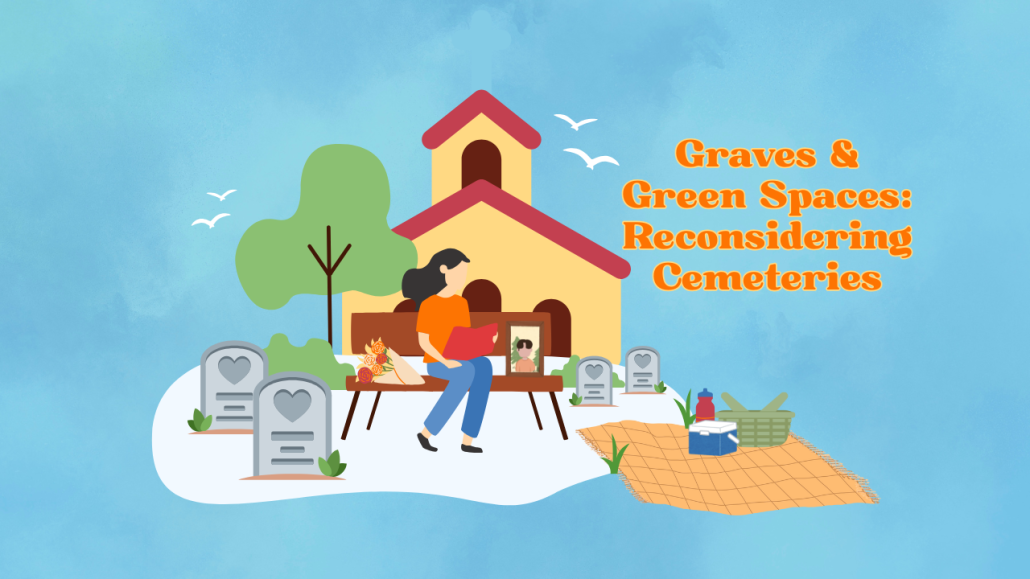

Graves and Green Spaces: Reconsidering Cemeteries
Although I find it a little shameful to admit, I tend to view cemeteries through a relatively narrow lens; cemeteries are for funerals, making us a little uncomfortable, and otherwise driving past without a second thought. Even with the tombstones seen dotted around peoples lawns in October, and despite the fact that they cover nearly 2 million acres of land in the United States alone, I rarely ever think about cemeteries as a whole.
I even drive by one of the public cemeteries near downtown Eau Claire often, and it rarely ends up in my thoughts. Recently, though, I couldn’t help but think to myself while passing it, “What if this space was a public park instead of a public cemetery?” After a moment of guilty consideration I realized that a cemetery essentially is a park; it also just happens to be a park dedicated to those of us who have passed on. Who’s to say I couldn’t use the Library’s online burial record search tools to find exactly where family is buried, go to the public cemetery, spread out a blanket, and read a book next to the dearly departed?
To begin, I thought that an abridged history of cemeteries in the United States would be helpful in understanding the public’s general attitude and treatment towards these spaces leading up to today. Cemeteries in the United States are mostly based on European Christian cemeteries, which began to form into what many of us would recognize as a “modern” cemetery (or what we would now classify as an urban cemetery) during the Middle Ages. Most of the graveyards at this time were run in populated areas by churches, as it was generally believed that it was necessary for people to be buried on church grounds in order to be considered a proper burial. The rich and powerful had detailed stone headstones and beautiful mausoleums; the majority had metal or wooden headstones that deteriorated quickly, and the least fortunate were added to mass graves and eventually exhumed and placed into ossuaries somewhere within the church. Cemeteries in Europe and the U.S. generally continued with these practices up to the early 19th century, other than some totally minor religious schisms, technological advancements, and social changes.
However, with steep increases in population due to the Industrial Revolution (18th-19th century), the rise of more contagious diseases, and the abundance of “untouched” land in the United States, the time came for implementation of a new kind of cemetery. These revised cemeteries are what we would now call “rural cemeteries,” named as such for being farther from urban areas and for having a focus on nature and beauty. Much to my surprise, these rural cemeteries were also essentially some of the first unofficial parks to be created in Europe and the United States, since many of them were funded and managed by local governments. In the United States, they especially took off as places of outdoor recreation. People would go to enjoy the detailed headstones and sculptures adorning people’s graves, socialize with friends and family, and have picnics. A large part of this was due to the frequency at which Americans were dying, so many saw this as a way to stay connected with their loved ones who had passed on in addition to now having a pleasant public outdoor space away from urban centers.
This naturally caused quite the debate among Americans about whether or not cemeteries were an acceptable place for anything more than short visits and leaving flowers. Some claimed that it was a healthy practice to have people enjoying the outdoors and staying connected to loved ones, while others argued that the littering and overcrowding was uncouth and disrespectful towards the dead. Regardless, it was short-lived, as this was also around the time that official public parks were starting to become popularized within the United States. With cemeteries on the decline (for picnics, not burials) and parks on the incline (also for picnics, not burials), using cemeteries in this fashion only ended up being a blip in time, and attitudes about cemeteries quickly shifted back to being places for quiet mourning and reminiscing.
With all of that being said, it didn’t really answer my question about whether or not cemeteries can be enjoyed recreationally, even if at one point they were. Ultimately though, it does feel like we have moved past the “golden age” of cemeteries being used for picnics and other outdoor recreation. While there are definitely certain activities that we do seem to generally agree are ok (walking a dog, going for a jog, appreciating the history, and, of course, visiting loved ones), the bottom line seems to be this: if you do decide to be a trendsetter and visit a public cemetery to crack open and read a book from the library, be respectful – both of those visiting, and those buried there.
*When possible, check for rules for the cemetery you plan to visit, like those listed here for our city-run cemeteries in Eau Claire.



Add a Comment
Now we'd like to hear your thoughts! Comments and suggestions are welcome!