

The Fourth of July and Frederick Douglass, America’s Most Famous Abolitionist
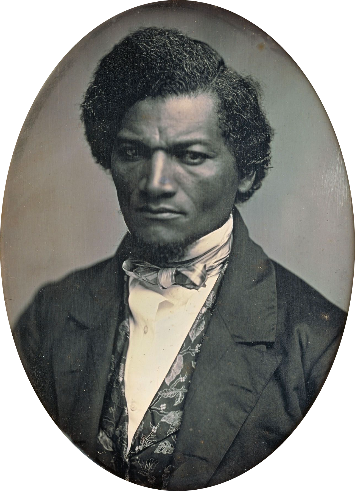
A portrait photograph of Frederick Douglass in his 30s, ca. 1847-1852, around the time he would have given his Fourth of July speech
The Fourth of July is a time for many Americans that evokes images of dazzling fireworks, barbequing, and general revelry. In a word, it is festive – a time for celebration of America’s independence from the British Empire, declared on July 4th, 1776.
Other Americans have had more complicated feelings on the holiday.
At a Fourth of July gathering hosted by the Rochester Ladies’ Anti-Slavery Association in 1852, the abolitionist activist and former slave Frederick Douglass gave what is likely his most famous speech. The audience included many luminaries of the day, including President of the United States Millard Fillmore – this was no minor celebration. Titled pointedly, “What to the Slave Is the Fourth of July?” Douglass offers a markedly different perspective on America’s Independence Day holiday as a man who himself escaped the thralls and violence of bondage.
The speech itself is worth a thorough read as Douglass spoke at length, but one doesn’t need to read far into it to realize that Douglass intends to give a rather unconventional speech for the Fourth. After a brief recounting of the historical circumstances of the American Revolution, Douglass levels with his audience:
“Fellow-citizens, pardon me, allow me to ask, why am I called upon to speak here to-day? What have I, or those I represent, to do with your national independence? Are the great principles of political freedom and of natural justice, embodied in that Declaration of Independence, extended to us?”
It is worth noting the pronouns he employs in this oration. He refers to America’s independence as “your national independence” – referring to white Americans. Douglass offers a forthright perspective on how the vaunted promises of liberty and democracy in the fledgling American republic resonated with white Americans, but not for African Americans, roughly 90% of whom were then held in slavery in the South in 1852. Indeed, he himself considers the Fourth to be a deeply somber occasion,
“The rich inheritance of justice, liberty, prosperity and independence, bequeathed by your fathers, is shared by you, not by me. The sunlight that brought life and healing to you, has brought stripes and death to me. This Fourth [of] July is yours, not mine. You may rejoice, I must mourn.”
Douglass does not mince words – he also describes the cruel practices involved in the institution of slavery, including the violent separation of families at auctions as a standard practice of the domestic slave trade. Here is an excerpt of him describing the heart-rending scenes of a slave auction,
“Attend the auction; see men examined like horses; see the forms of women rudely and brutally exposed to the shocking gaze of American slave-buyers. See this drove sold and separated forever; and never forget the deep, sad sobs that arose from that scattered multitude. Tell me citizens, WHERE, under the sun, you can witness a spectacle more fiendish and shocking.”
Indeed, in America’s capital city of Washington, D.C., the slave trade had only been outlawed a few years prior to Douglass’s speech. And in the cities of the South, from Richmond to New Orleans, the slave trade continued apace in the run up to America’s civil war, generating millions of dollars for its purveyors.
Douglass also forcefully criticized the Fugitive Slave Law of 1850, which allowed slave hunters and federal marshals to forcibly deputize people anywhere in the country – including the free North – to serve as slavecatchers for enslaved persons trying to escape to freedom. This was done on pain of a heavy fine or even imprisonment. This was a law decried by Douglass as one borne of “diabolic intent.” It made freedom and liberty everywhere in America a cruel joke – it was “tyrannical legislation.”
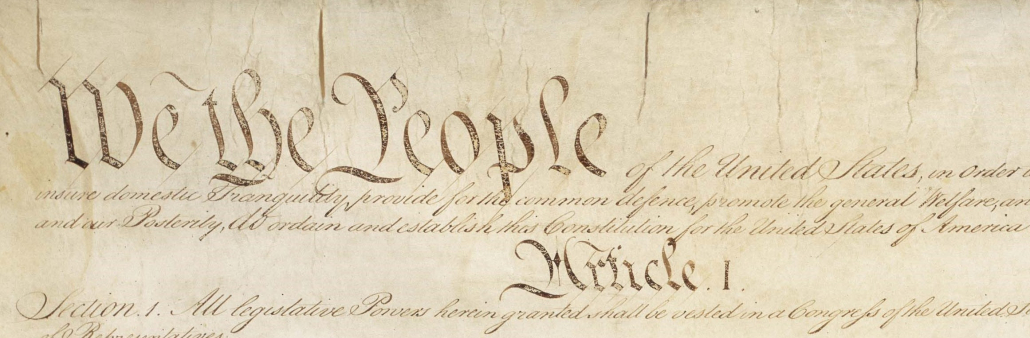
But there is a considered nuance in Douglass’s words about the United States that is also worth noting. While decrying the present-day hypocrisy of America for its continued sanctioning of slavery and the violence it entailed, he also notes the resilient power of its foundational principles. And of the Constitution, he argues against the popular view of the day that it allows and protects slavery, instead declaring that the Constitution is a “GLORIOUS LIBERTY DOCUMENT [sic].” Douglass’s argument is that by committing firmly to the true principles of the Constitution and Declaration of Independence, a terrible injustice can be ended.
In other words, while America has visited atrocious wrongs upon the enslaved, redemption can be found, and freedom’s promise extended to all people. This, to Douglass, is the way to prove America’s commitment to the self-evident truth of human equality espoused by the Declaration of Independence.
In this way, there is also an incredible hopefulness that suffuses Douglass’s speech, even as he decries America’s hypocrisy. Douglass concludes the speech by noting that ultimately, he is optimistic that the downfall of slavery is at hand,
“Allow me to say, in conclusion, notwithstanding the dark picture I have this day presented of the state of the nation, I do not despair of this country. There are forces in operation, which must inevitably work the downfall of slavery…While drawing encouragement from the Declaration of Independence, the great principles it contains, and the genius of American Institutions, my spirit is also cheered by the obvious tendencies of the age.”
Douglass would prove vindicated in time: a little over 13 years later, in 1865, the 13th Amendment abolishing slavery would be ratified to the US Constitution.
All quotes are from the full text of Douglass’s speech: Douglass, F. (1852, July 5). What to the Slave is the Fourth of July?, Full Text. The Root, https://www.theroot.com/what-to-the-slave-is-the-fourth-of-july-1836083536


Add a Comment
Now we'd like to hear your thoughts! Comments and suggestions are welcome!