

Ode to Library Programs
“Why don’t I do this more often!?” Sometimes you just need a tiny, little nudge and a dash of conscious effort to find your way back to your passions; one of mine is poetry. I used to belong to a monthly poetry group where we read and discussed each other’s poems, as well as works by published poets. We came to know each other on quite a deep level, and it was so much fun getting together with like-minded, friendly fiends. I remember how the group chuckled at one of our meetings when I exclaimed: “We must be severe poetry nerds” after a very long discussion about how the interpretation of a specific passage may change—due to the placement of a comma.
My “re-entry” into poetry writing happened during this beautiful, past month of May, thanks to a three-week poetry workshop series at the library. It was held by Dorothy Chan, a local (and international) poet and Assistant Professor of English at the University of Wisconsin-Eau Claire. The series was called “Sonnets and Food” because she loves that particular poetic form and is passionate about sharing her heritage of the Chinese-American kitchen (and other cuisines) in her poems.
Poetry can sometimes be regarded as introverted and incomprehensible (not that there is anything wrong with that) but I see both reading and writing poetry mainly as communication. In my poetry group it was equal parts exhilarating and scary to express yourself through poetry, and it always fascinated me how the group members’ own life experiences impacted their interpretations. Quite often the writer would be surprised when the conversation revealed themes they had not consciously recognized in their own poem: “You’re absolutely right; I can’t believe I didn’t see that!”
From other writing courses I had learned that introducing some kind of restriction, such as a particular format or technical requirement, will help you unleash creative powers you might not have been aware of before. A famous example is the French author Georges Perec, who went a little extreme and wrote an entire novel without using the letter E. This technique is called “constrained writing” and I think all the poetic forms that have developed throughout human history could be viewed as “challenges”—or useful tools to refine your thoughts and reach the core of what you are trying to express. Dorothy Chan also emphasized that using the brief format of poetry forces the writer to choose their words more carefully and efficiently.
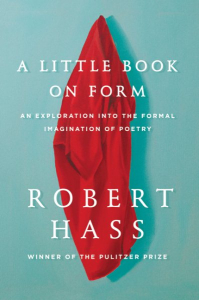 After the workshop series, I was inspired to check out some of the library’s resources. For a multitude of examples of poetic forms, the former U.S. poet laureate Robert Hass’ A Little Book on Form is very informative. When browsing through this book, I realized how much poetry is a “numbers game.” Hass devotes entire chapters to talk about examples of just a single line of poetry and then two lines (couplets,) three lines (tercets,) and four lines (quatrains,) before introducing other forms, such as sonnets, odes, and elegies.
The library workshop was fully devoted to the sonnet, which traditionally contains 14 lines, each with 10 syllables. In my old poetry group, we once challenged ourselves to write sonnets using the exact rules, including specific rhyming patterns. Dorothy Chan “allows” a more modern take on the sonnet, without rhyming and approximately 10 syllables per line. She drew an interesting parallel to the oral culture beginnings of poetry; apparently, we use about 10 syllables to express one line of thought while speaking. She encouraged us to observe this pattern in everyday speech situations. I liked how she made poetry less of an intellectual exercise by suggesting that we read out loud while writing the poem (which also helps you find your style/voice) and to count out syllables with your fingers (to find rhythm.)
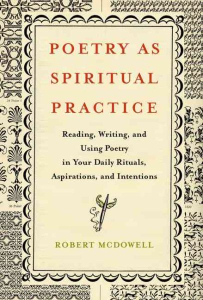
There is of course much more to poetry than concrete writing rules. Poetry as Spiritual Practice by Robert McDowell contains a ton of practical exercises, to be used for your own exploration and for building community (almost every chapter includes “Collaborative Exercises.”) The book’s subtitle Reading, Writing, and Using Poetry in Your Daily Rituals, Aspirations, and Intentions suggests that poetry is a powerful “tool” for self-discovery. A review quote on the back-cover states that the author “helps you articulate that deep place of truth for yourself.”
I really enjoyed McDowell’s examples of poetry from all eras and temperaments, such as this cheeky definition of poetry itself, by Tukaram, a 17th century Indian mystic poet:
There’s a hole in the palace wall.
A good poem is like that!
You never know what you might see.
Or this more modern, intricate example of a simile (comparison of two unlike things) by a contemporary American poet, Kim Addonizio: “Love me like a wrong turn on a bad road late at night.”
Poetry is to me an artform full of contradictions and mysteries. At the same time, it can be the quickest read, but you may need to take your time to decipher its deepest meaning. Dorothy Chan said that the mark of a good poem is that you want to reread it.
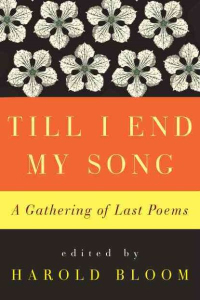
There are as many styles and expressions as there are poets; I would suggest browsing anthologies to find a specific poet that appeals to you. For new, contemporary poetry there are the yearly volumes of Best American Poetry. Other anthologies that cover specific subject matters or areas of interest are: African American Poetry: 250 Years of Struggle and Song, (names mentioned in the poems range from Adam and Eve, to Frederick Douglass, Uncle Tom and even Beyoncé,) Baseball Haiku (who knew!), The Star-Nosed Mole: An Anthology of Scented Garden Writing (botanical poetry paired with photos), or Till I End My Song: A Gathering of Last Poems (an anthology of classic poets’ last poems.)
Lastly, I will face the fear, embarrassment, and self-critical monster, by just sharing the sonnet I wrote in the May workshop. The format is modern (about 10 syllables per line and no rhyming) and I paid attention to some of Dorothy Chan’s suggestions: ending each line with an interesting word, using the cataloging technique, and considering the use of pronouns.
Underground Movements
Hopelessly devoted to your everyday chores:
slightly burnt oatmeal, work email, chasing your tail,
driving on potholes, or more like rabbit holes;
every time you try to avoid one, another one swallows
you whole, cracks and all—thanks for nothing Leonard
Cohen—the light is really way too harsh.
There’s a rip in the fabric of our interdependence;
no way to outrun the runs in Mother Time’s
stockings. You know the lowest possible point
is the Mariana Trench, but your own war
is perhaps just skin deep. Bugs, gnats, ear worms,
itsy spider bites, drones, stingers, butterfly
effects, hive minds. Are you in fact the canary
in the mine? Let’s see you dig yourself out of this one.
What’s your passion? Make sure to put your public library to use! Check and browse our calendar for programs – there are options for different age groups and interests throughout the year. The library’s first Maker in Residence, Jenna Vande Zande, will reside in the Dabble Box during the month of June. Check out her hours and sign up for the workshops here. Other current and upcoming types of group events are book groups, writing groups, Stitch Club, programs about games, arts, genealogy, and much more. Any questions? We will be happy to help at any of the public desks or via phone or email. Drop us a line, or a couplet, tercet, quatrain…


Add a Comment
Now we'd like to hear your thoughts! Comments and suggestions are welcome!